If you ask Molly Carson, the commercial real estate industry is facing many challenges in 2026, but the industry is ready to face those obstacles head-on.
“These challenges include power accessibility, assurance of water, and opposition to development in certain areas,” says the executive vice president and market leader for Ryan Companies US. “We are preparing for this by staying informed, actively engaging in the communities where we serve, and being mindful of political dynamics.”
LEARN MORE: AZ Big 100: 50 Arizona companies to watch in 2026
DEEPER DIVE: AZ Big 100: 50 Arizona commercial real estate companies to watch in 2026
Identifying challenges in Arizona’s commercial real estate industry for 2026 and beyond is essential because it allows stakeholders — developers, investors, and policymakers — to anticipate headwinds like interest-rate pressure, office vacancy surges, and infrastructure constraints. Addressing these issues proactively preserves deal flow, supports sustainable growth, and protects long-term market value.
AZRE magazine talked with some of the most forward-thinking leaders in Arizona’s commercial real estate industry and asked them to identify the challenges they expect to face in the years ahead — along with the opportunities the industry has to overcome those challenges.

Lorraine Bergman, CEO and president, Caliente Construction: “The skilled labor shortage is a key challenge. We’re investing in workforce development by partnering with schools and organizations to stimulate interest in the construction industry. Public policy continues to affect the stability of material pricing and availability. We focus on educating our clients and employees on ways to minimize the long-term impacts of these challenges to keep projects viable.”
Bryon R. Carney, managing principal, Cushman & Wakefield: “The competition for top talent has never been more intense. To succeed, it’s essential to provide a work environment that fosters a positive culture and offers competitive compensation. By prioritizing these factors, you can attract and retain the best talent in the industry.”
Larry Downey, vice chairman, Cushman & Wakefield: “The commercial real estate office sector must adapt to hybrid work models, optimizing space through right-sizing and balanced expansion or downsizing to improve efficiency. We proactively embrace changes with tailored solutions, relocations, and data-driven strategies, reducing costs and ensuring our clients succeed in an evolving market driven by flexibility and innovation.”

Andrew Geier, executive vice president, Layton Construction: “The cyclical nature of our business, combined with the general policy uncertainty in Washington, creates both challenges and opportunities. We’ve built a diverse, adaptable portfolio by project type and geography, allowing us to quickly pivot toward the sectors delivering the strongest returns.”
Sharon Harper, chairman and CEO, Plaza Companies: “In an era of uncertainty, Plaza Companies will continue to rethink and refine our approach in how we navigate change. The future for Plaza Companies is built on optimism with diligence, consistency, and persistence. Plaza Companies strives to work in a broad base of construction types and industries to ensure we are positioned for success.”
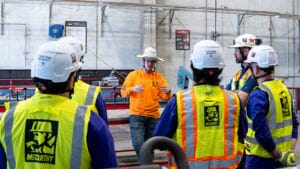
Justin Kelton, CEO, Southwest Region, McCarthy Building Companies: “We are focused on addressing the ongoing workforce shortage and the continued need for a well-trained skilled craft workforce. McCarthy has launched various initiatives aimed at cultivating and developing the next generation of skilled professionals by partnering with institutions like West-MEC, EVIT, and Grand Canyon University to generate interest in the many varied and rewarding career opportunities in construction. In 2021, we strengthened this commitment by opening our Innovation & Craft Workforce Center in Chandler to train and prepare our workforce. It’s been a game-changer for McCarthy, highlighting our commitment to craft careers and advancing quality installations across our projects.”

Jonathan Keyser, founder and managing partner, Keyser: “The biggest trend in commercial real estate is the rise of agentic AI — intelligent systems that act on behalf of users to analyze markets, identify opportunities, and streamline transactions. Keyser is preparing by doubling down on our service standards and commitment to transforming the industry through conflict-free, tenant-focused advocacy. At the same time, we’re maintaining a disruptive, technology-embracing mindset, ensuring we stay ahead of the curve and deliver cutting-edge solutions that empower the business leaders we serve.”
Tim King, owner and CEO, HACI Mechanical Contractors: “The construction industry has an industrywide shortage of over 500,000 workers. In Arizona, HACI provides high wages, generous benefits, and training programs to attract and retain the tradespeople necessary for HACI’s projects.”
Bob Mulhern, managing director-Arizona market leader, Transwestern: “Like most industries, commercial real estate has incredible challenges ahead thanks to the disruption AI is bringing to businesses large and small. For companies like Transwestern, which have the financial muscle of a large firm and the finesse of much smaller firms, the future will be filled with incredible opportunities!”
Todd Noel, vice chairman, Colliers International: “The Phoenix market has been strong, but it faces several key challenges over the next five years, including occupiers of office space continuing to struggle with projecting mid- to long-term needs (and how employees will want to occupy space). Additionally, rising interest rates, the cost of capital, overall economic uncertainty, and market cycles will impact us. I am preparing for these challenges by staying informed and knowledgeable, including staying updated on how other major markets are handling these challenges.”

Jackie Orcutt, executive vice president, CBRE: “A lot of my work is tied to specialized manufacturing, which requires heavy power. Coupled with the robust semiconductor, electric car/battery, and data center industries, power supply will be a large focus for years to come. My team is spending time preparing our developer clients and working with renewable energy companies to help provide long-term resources for power generation.”
CJ Osbrink, executive managing director, Newmark: “Economic uncertainties, such as interest rate changes and market volatility, could continue to impact financing conditions and investment strategies. Since this is largely out of our control, the best way to prepare for it is to stay informed about economic trends in order to help my clients make informed strategic decisions.”
Steven Schwarz, founding partner, ViaWest Group: “Political and geopolitical issues (which directly lead to economic issues) always seem to be at the forefront. When these are combined with a strain on our natural resources of energy, water, and air quality, it requires us to think multiple steps ahead and plan for the unknown. After ViaWest’s 20-plus years of managing through this, we think we have developed the appropriate discipline, culture, and foresight to prepare well for a variety of scenarios.”
Patricia Watts, co-founder, Greenlight Communities: “The apartment industry faces challenges from rising costs and limited land. Once current oversupply is absorbed, rental housing — especially affordable options — will be scarce, increasing rent burden. Our team is proactively buying land and value-engineering our product to maintain a low-cost, attainable housing option for future renters.”
Brad Woodman, vice president, Southwest region director, SmithGroup: “The architecture, engineering, and construction industry faces significant challenges due to unpredictable economic trends and the digital transformation driven by AI. Artificial intelligence’s impact will revolutionize how we deliver services and products to our clients and potentially transform our workplace and work environment.”