Arizona and Florida rank among the most-watched real estate markets in the country, and for all the good reasons. Both have posted years of outsized population and job growth, both attract heavy investor capital, and both are frequently mentioned in the same breath as top Sunbelt growth stories. But the forces actually driving each market are genuinely different, and investors weighing one against the other need more than a simple growth-rate comparison to make a sound decision.
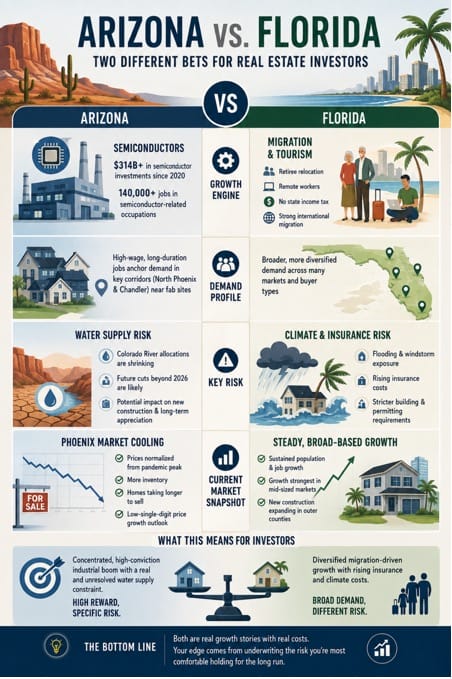
Arizona’s growth engine: semiconductors
Arizona’s investment case is increasingly a story about one industry: semiconductors. Since 2020, the state has attracted more than 70 semiconductor-related expansions representing over $314 billion in investment, the most of any state in the country.
TSMC alone has grown its Arizona commitment from an initial $12 billion in 2020 to $265 billion, spanning up to 12 planned facilities near Phoenix. Intel, which has operated in Arizona for more than four decades, has its largest global manufacturing site in Chandler and has committed a further $20 billion to two additional fabs.
This isn’t abstract economic development talk. According to the Greater Phoenix Economic Council, the metro area already has more than 140,000 jobs in semiconductor-relevant occupations, a number growing quickly as new fabs come online.
For real estate investors, this matters because semiconductor manufacturing jobs are high-wage, long-duration positions that anchor housing demand in specific submarkets, particularly the North Phoenix and Chandler corridors closest to the fab sites, in a way that’s more predictable than tourism-driven or retiree-driven demand tends to be.
It’s worth understanding the timeline here too. TSMC’s second fab, using more advanced 3-nanometer process technology, has already completed construction, with volume production expected in 2027.
That means a meaningful share of the promised job growth is still ahead and is not yet priced into the current market, which is one reason some investors view Phoenix’s current price plateau as an entry window.
Florida’s growth engine: migration and tourism, not a single industry
Florida’s growth story runs on a broader and more diversified base. Rather than one dominant employer or industry cluster, Florida’s population growth is driven by a combination of retiree relocation, remote-work flexibility, the absence of a state income tax, and strong international migration, with the state consistently ranking among the national leaders in net international arrivals.
That diversification cuts both ways for investors. It means Florida’s demand isn’t dependent on any single company’s expansion plans continuing on schedule, but it also means the growth is more dispersed and harder to target at the submarket level the way an investor can target neighborhoods near a specific Arizona fab.
The variable that changes everything: Arizona’s water supply
Here’s where the comparison gets genuinely serious. Arizona’s Colorado River allocation, which currently supplies roughly a third of the state’s total water use, has been shrinking for years under federally mandated shortage tiers tied to reservoir levels at Lake Mead and Lake Powell, and both reservoirs remain well below historical capacity after a multi-decade drought.
Federal water managers are now working through a longer-term operating framework for the river covering the years beyond 2026, and every version of that framework under discussion involves further reductions to Arizona’s share, with the state’s own water department publicly warning that the most aggressive scenarios under consideration could meaningfully damage the state’s economy.
The exact size of future cuts remains unsettled and is likely to keep shifting as negotiations between the seven Colorado River basin states continue, so investors shouldn’t anchor to any single figure.
What matters for underwriting purposes is the direction and the structural nature of the problem: Arizona’s primary imported water source is shrinking, the state’s own agencies acknowledge it, and the timeline for a permanent resolution keeps extending.
The Central Arizona Project, which delivers most of this water to metro Phoenix and Tucson, has said cities are prepared to manage through additional cuts without service disruptions, but conservation measures, efficiency requirements, and potential drought surcharges are increasingly likely as part of that management.
This matters directly for real estate investors evaluating new construction and long-term appreciation. Semiconductor fabs themselves are water-intensive operations, and Arizona’s chip manufacturing boom is unfolding at the same time its primary imported water supply faces long-term reductions, a tension that’s drawn increasing public attention in the state.
Florida’s resource risk runs in something closer to the opposite direction: too much water, not too little, in the form of flood exposure, windstorm risk, and the insurance costs that follow both.
Both states carry a resource-driven risk that shows up in insurance costs, permitting requirements, and development timelines. They’re simply inverse versions of the same underlying problem, and both deserve the same level of underwriting scrutiny.
Comparing where price growth actually sits
Phoenix’s housing market has cooled meaningfully from its pandemic-era boom. Median home values across various measurement sources have run in a wide range depending on methodology, with year-over-year figures landing anywhere from modestly negative to modestly positive, alongside rising inventory and homes taking somewhat longer to sell than at the peak of the earlier boom.
Most analysts characterize this as a normalization instead of a downturn, with near-term price growth forecasts generally landing in a low-single-digit range, supported by continued job growth even as the broader market rebalances toward buyers.
That cooling matters for how investors should read Arizona’s growth story. The semiconductor investment is real and enormous, but it hasn’t translated into runaway price appreciation the way it might have during the earlier boom years.
That’s arguably a healthier entry point for investors who missed the earlier cycle, provided the water situation doesn’t materially constrain new supply in the specific submarkets tied to fab employment over the coming years.
What this means for a diversified investor
Neither state offers a clean, risk-free growth story, and that’s the more useful takeaway than picking a single winner.
Arizona offers a concentrated, high-conviction bet tied to a specific and enormous industrial buildout, paired with a real and currently unresolved water supply constraint that deserves serious underwriting attention before committing to new construction in the Phoenix growth corridors.
On the other hand, Florida offers a more diversified demand base spread across retirees, remote workers, and international arrivals, with insurance and climate costs functioning as the long-term risk factor investors need to price in instead.
For investors looking at Florida specifically, fl homes for sale inventory show meaningful variation in much the same way Arizona’s submarkets do, with growth concentrated less in the highest-profile coastal metros and more in mid-sized counties that still have room to build out supply. Markets like Tampa real estate listings illustrate this dynamic from the demand side: strong, sustained population and job growth, but with new construction increasingly pushed to the metro’s outer counties as the urban core stays supply-constrained, a pattern that echoes the demand-outpacing-supply pressure investors are also watching build around Arizona’s fab corridors.
The bigger picture for anyone comparing the two states: this isn’t a question of which one is “safer” in the abstract. It’s a question of which specific risk an investor is more comfortable underwriting long-term, a concentrated industrial boom paired with a genuine and still-unfolding water supply question in Arizona, or a diversified migration-driven boom paired with rising insurance and climate costs in Florida. Both are real growth stories, grounded in verifiable economic activity. Both come with a real, ongoing bill attached, and that bill is exactly what separates a well-u