Many Phoenix buyers understandably avoid house hunting during the hottest part of summer. Showings can be uncomfortable and inconvenient, but they can also provide some of the most useful information a buyer will get.
Peak heat is one of the clearest tests of how a home actually performs. A property may show well in March, but the summer months reveal something different. Heat exposes whether the home’s systems, layout, orientation, and outdoor spaces are working with the desert climate or constantly fighting against it.
That matters because the purchase price is only one part of the financial picture. In the Valley, the electric bill is essentially part of the mortgage. A home that is inefficient, poorly shaded, or difficult to cool can create long-term costs that are easy to miss during a mild-weather showing.
DEEPER DIVE: Arizona races to reskill workforce before wave of 700,000 new jobs hits
INDUSTRY INSIGHTS: Want more news like this? Get our free newsletter here
HVAC performance should be the first test
Air conditioning is not a luxury feature in Arizona. It is part of the core infrastructure.
During a summer showing, buyers should compare the thermostat setting to the actual indoor temperature. If the thermostat is set to 74 degrees but the home is sitting closer to 80, that is worth a closer look. The system may be undersized for the square footage, poorly maintained, aging, or struggling because of the way the home is designed.
That does not automatically mean the home is a bad purchase, but it should prompt more questions. Buyers should ask about the age of the unit, maintenance history, recent repairs, and whether the system was properly sized. If additions or renovations have changed the square footage, the cooling system may not have been updated accordingly.
An inspection can help clarify the issue, but buyers should also pay attention to what they feel during the showing. If the home cannot stay comfortable under normal summer conditions, that information should factor into the decision.
Hot spots reveal hidden performance issues
A home can feel generally cool and still have problem areas. Rooms along south- and west-facing exterior walls tend to take the most intense afternoon heat. If one bedroom, office, or living area feels several degrees warmer than the rest of the house, the issue could be insulation, airflow, ductwork, windows, or an improperly balanced AC system.
These hot spots matter because they affect daily livability. A home office that becomes uncomfortable every afternoon or a child’s bedroom that never cools properly may create ongoing frustration. Buyers should also pay attention to rooms over garages, converted spaces, and additions because they may not perform the same way as the original structure.
The goal is not to find a perfect home. The goal is to understand what may need attention and what those fixes could cost.

Windows and shade shape comfort
West-facing windows can have a major impact on indoor comfort. Some solar heat near a window is expected, especially in the afternoon. But if a window radiates intense heat into the room, buyers may eventually need to consider improvements such as window coverings, tinting, exterior shad
Buyers should look at where the sun hits the home in the afternoon, not just how the property appears in listing photos. South- and west-facing exposures deserve particular attention.
Outdoor areas need to function in summer
Outdoor space is a major selling point, but buyers should evaluate whether that space is actually usable during the hottest months.
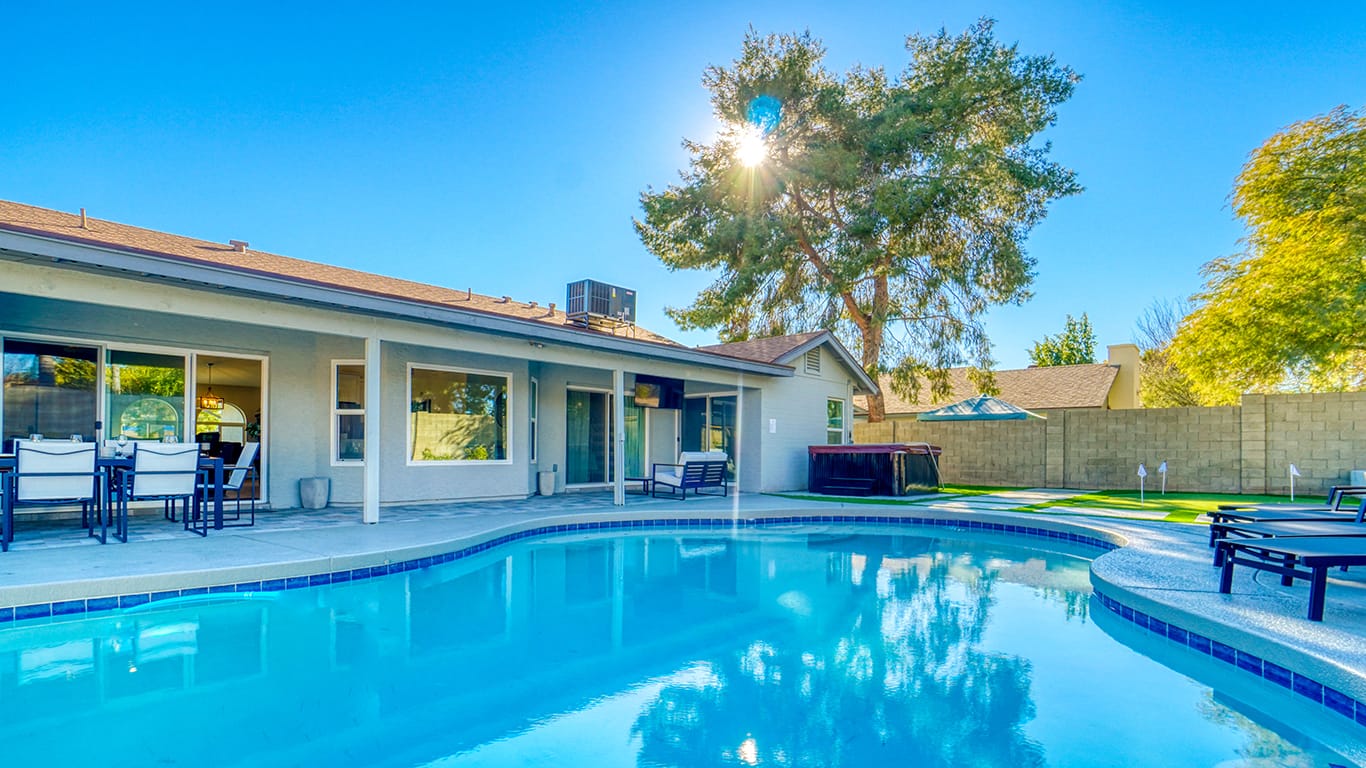
A covered patio, shade structure, misting system, pool orientation, and heat-resilient landscaping can all affect how the yard functions. Artificial turf should also be evaluated carefully. It may look clean and low-maintenance, but it can become extremely hot in direct sun, especially for pets and children.
The same logic applies to garages. Many are non-conditioned or only semi-conditioned, but their design and position relative to the home can affect how hot they get. Excessive garage heat can damage stored items and transfer into adjacent living spaces. If a garage becomes extremely hot within a short period of time, buyers should think carefully about what they plan to store there and whether improvements such as insulation or ventilation may be needed.
Monsoon season provides a second stress test
Summer also brings another useful evaluation tool: monsoon season.
In a dry climate, drainage problems can be easy to miss until a heavy storm arrives. Buyers who are seriously considering a home may benefit from driving by shortly after rain. Water pooling near the foundation, yard flooding, poor roof drainage, or standing water in the street can all reveal issues that may not be obvious on a sunny day.
A showing the day after a monsoon can also be informative. Buyers should look for signs of water intrusion around windows, doors, baseboards, and ceiling drywall. Even small signs of moisture should be investigated because water issues can become expensive if ignored.
The bigger takeaway
Buying a home here requires evaluating more than finishes, floor plans, and location. Climate performance matters. A home’s HVAC system, window efficiency, shade coverage, garage temperature, outdoor usability, and drainage all influence comfort, cost, and long-term value.
Touring homes during extreme heat may not be pleasant, but it can give buyers valuable information. In a market where every dollar matters, understanding how a property performs under real desert conditions can help prevent expensive surprises and lead to a more confident purchase decision.
Author: Trevor H. Halpern, J.D., is the CEO of Halpern Residential at eXp and eXp Realty’s #1 independent agent in Phoenix. A Phoenix native, Halpern combines deep local expertise with a client-focused approach, creating success stories across every corner of the Valley. A graduate of ASU’s College of Law, he is known for his high-level strategy, sharp negotiation skills, and precise tactical execution. Since launching his real estate career in 2011, Halpern has closed more than $330 million in sales, ranks in the top 1% of agents in Greater Phoenix, and has been recognized by RealTrends as one of the top 1,000 agents in the United States out of 1.5 million.