Whether it’s the architect’s drafting program or a craftworker’s hammer, tools are critical to the completion of any project. As technology advances, the industry now has more opportunities than ever to rethink how to approach construction challenges, optimize operations and enhance worker safety.
Paola Sanguinetti, director of The Design School at Arizona State University’s Herberger Institute for Design and the Arts, notes that implementing more automation has been a growing trend in the sector.
“The construction industry is fragmented because of the variety of companies and trades. It’s a very complex space, but we’re looking at manufacturing and technology to help bring more efficiency to the process,” she continues.
One of these methods with the potential to revolutionize how buildings are erected is 3D printing. This technology has been around for some time, with entry-level, consumer-grade printers widely available for a few hundred dollars. Those products typically dispense melted plastic filament according to a plan set, creating an object from the ground up.
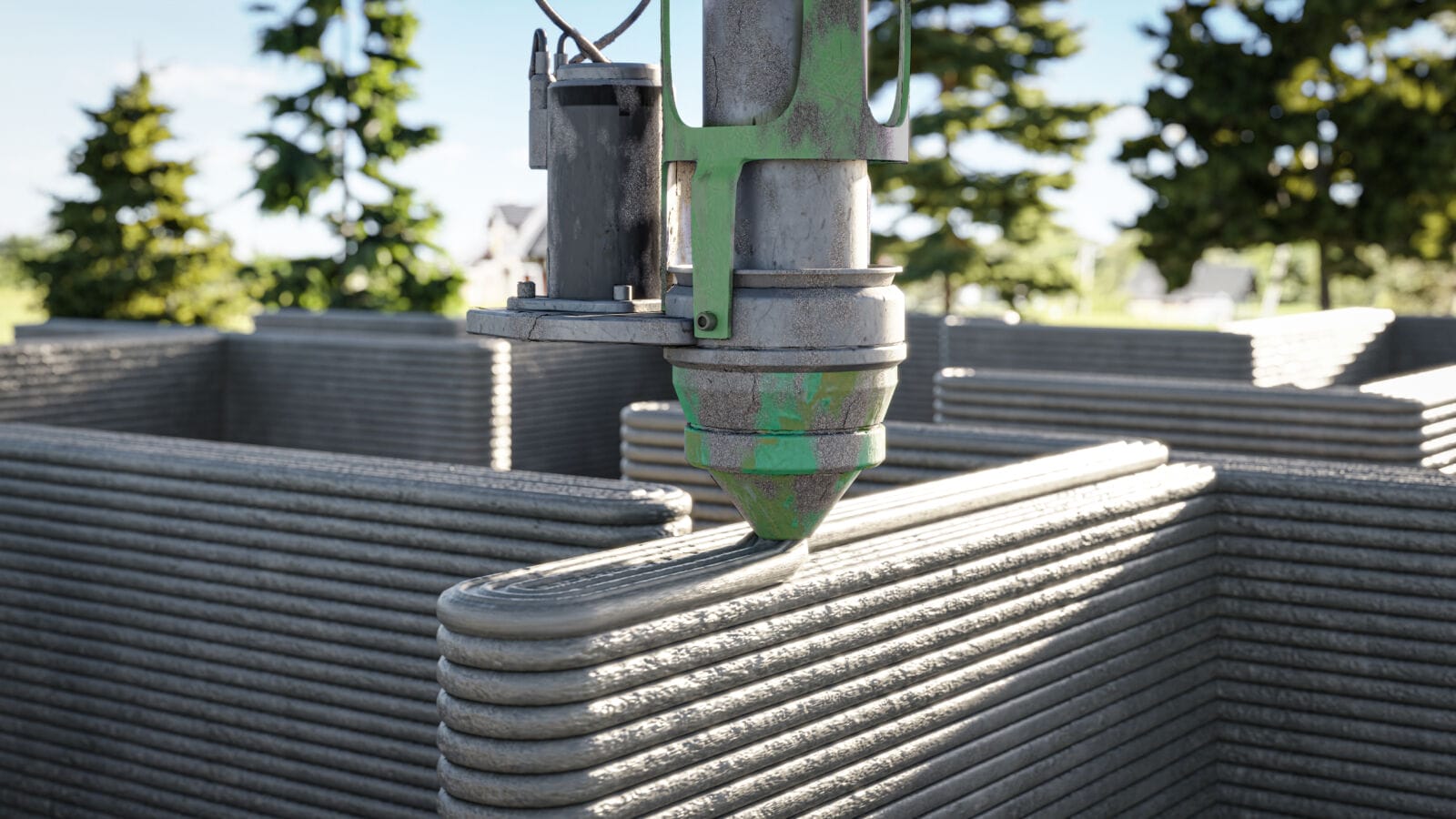
When applied to construction, software breaks down the digital model of a structure to align with the printer’s workflow. A robotic arm then extrudes the chosen building component layer by layer. Sanguinetti notes concrete is a common medium, but using it comes with challenges.
“There is research out of [ETH Zurich, a university in Switzerland] looking at using a bed of dry material instead, so what you’re actually printing is the heat or fusing material to bind it together,” she explains. “It’s a much cleaner and precise way of doing 3D printing.”
In 2021, Habitat for Humanity used a 3D printer to build more than 70% of a 1,738-square-foot home, including all the internal and external walls. Sanguinetti visited the site while it was under construction, saying that “it was amazing what they were able to do.”
“[Habitat for Humanity] partnered with [PERI], who had developed the printing process with the climate of Germany in mind,” she continues. “They were doing it in the summer, and the concrete started to dry [too quickly]. That’s one of the learning curves when 3D printing any wet material. Environmental variables are critical to the fusing, drying and curing processes of concrete.”
Finding the right mix of inputs for the printing process while emphasizing sustainability is one focus on Sanguinetti’s own research. Geopolymer concrete, which replaces Portland cement with fly ash, is an option that shrinks the embodied carbon of the structure. Another way to minimize the total volume of concrete needed is by adding something called phase change materials.
“They allow you to reduce the thickness of walls, because those materials absorb and release heat, giving the walls greater insulating properties. That reduces energy loads for cooling and heating — very useful in an environment like Arizona,” Sanguinetti explains. “But as you add these components, it impacts printability, so we’re trying to find the right ratio.”
In the commercial context, Sanguinetti notes that some companies are exploring how to use 3D printers to prefabricate components off-site, much like tilt-up construction. Aspects of a project that require more detailed work, such as facades, are harder to create with the exactitude those elements require.
“3D printing is fundamentally shifting the way we build,” Sanguinetti says. “It improves efficiencies, reduces labor need and enables fabrication to happen more quickly, whether it’s happening on site or off it.”
Reducing risk
Beyond changing how buildings can be constructed, technology is also being used to create additional protections for workers and the wider public. In April, Sunstate Equipment announced it is deploying Netradyne’s Driver•i D-450 platform across the company’s fleet of service and delivery vehicles to bolster driver safety.
The new system provides a 270-degree view via a four-camera array, enhancing visibility. It also incorporates AI elements that give drivers real-time alerts, enabling them to self-correct before a problem occurs.
MORE NEWS: How Arizona data center construction will explode with AI adoption
INDUSTRY INSIGHTS: Want more news like this? Get our free newsletter here
“If you’re in a big semi, your focus is on traffic and spacing,” explains Mike Safsten, director of safety and risk at Sunstate Equipment. “We’ve had at least three situations where the cameras recognized and prompted the driver of a pedestrian that he or she couldn’t see, preventing a potential incident.”
While the system is not integrated into the mechanical function of the vehicle, it does recognize unsafe conduct on the road. If a Sunstate driver is speeding, they will be given three audible prompts to slow down.
Ignoring those warnings will cause the cameras to start capturing video, which is sent to both the driver and their manager.
From there, the supervisor can call and coach the employee in real-time to manage expectations. But the purpose of the system isn’t to point fingers when people make mistakes — safe driving practices are also recorded to celebrate good habits.
Safsten also stresses that the goal is to reduce the likelihood of accidents, not constantly surveil employees. Even though the cameras are always rolling, he and others only see the video feed when warnings are being ignored or if a collision occurs.
“I see it as a driving partner as opposed to a way to catch people doing something wrong,” he continues. “This technology helps the driver remain focused on the task at hand. Life is hard, and there are more distractions now than ever. These cameras help them see what they cannot and get the load to the customer safely.”
Buy-in from both management and drivers is needed for the successful implementation of a system such as this.
“Just putting it in place isn’t going to do it,” Safsten concludes. “You need a culture that accepts this level of monitoring power in the cab. Without trust, there’s risk of breaking relationships and disrupting operations if you don’t do the groundwork on the human side first.”