The “15-minute city” concept has sparked heated online debate. Advocates describe it as a straightforward planning approach meant to make daily essentials easier to reach within a short walk, bike ride, or transit trip. That includes groceries, parks, schools, healthcare, fitness, and other services. The payoff is convenience and flexibility, and the model still allows people to drive when they want to reach destinations beyond their immediate area. Critics, however, argue the idea has less to do with convenience and more to do with controlling population movement.
READ MORE: Here is the outlook for Phoenix’s 2026 housing market
LOCAL NEWS: Want more stories like this? Get our free newsletter here
In metro Phoenix, the 15-minute city conversation is emerging at the same time buyer preferences are shifting. Younger buyers are placing greater value on walkability, access to transit, and proximity to the places they use most. In real estate terms, “location” is getting more granular. It is not just the neighborhood, but whether daily life feels connected and easy.
Culdesac Tempe is an early test case
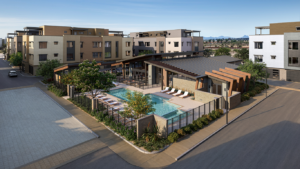
The most visible local example is Culdesac Tempe, a car-free, mixed-use development intentionally located next to Valley Metro light rail. It was designed to prioritize walkability, with shaded routes through the community and retail and services on-site. Culdesac has also emphasized desert heat mitigation in its design, including extensive shade and a “zero asphalt” approach described by the developer.
Culdesac is not a template Phoenix can apply everywhere. But it is a useful signal that demand exists in the Valley for communities that reduce car dependence and make short trips realistic.
Phoenix is more likely to retrofit than rebuild

Phoenix is not going to flip into a car-free city. The more realistic path is gradual: add 15-minute city principles through policy and infrastructure, especially around transit corridors and areas positioned for mixed-use infill.
Here are the local levers that matter most:
• ADUs and infill that add gentle density: Accessory Dwelling Units (often called casitas) can expand housing options without dramatically changing neighborhood character. When ADUs are paired with infill development, they support the kind of incremental density that makes neighborhood-serving retail and services more viable.
• Light rail expansion that creates development corridors: Transit is central to any 15-minute model. Valley Metro’s South Central Extension and Downtown Hub opened June 7, 2025 and created a two-line, roughly 35-mile light rail system. Over time, expanded rail corridors tend to attract more mixed-use development near stations, supported by zoning and planning decisions.
• Walkable Urban Code near stations: Phoenix has implemented a Walkable Urban Code within the city zoning ordinance. The city describes this framework as regulating development near light rail stations to encourage more walking, biking, and transit use, along with mixed-use patterns and shade-oriented design standards.
• Bike infrastructure that makes short trips possible: A functioning 15-minute pattern depends on safe routes. Phoenix continues to plan and build bike infrastructure, including protected and separated facilities on key corridors. Better bike connections can turn “close enough” neighborhoods into places where people actually choose not to drive.
What this means for the Phoenix real estate market
When neighborhoods become easier to live in without constant car trips, buyers tend to notice. Proximity and connectivity become part of the value proposition, not just the home itself. From an investment perspective, that often translates into more attention on infill opportunities near transit and along corridors where zoning supports walkability and mixed use.
The caution is that these benefits can be concentrated. Not every neighborhood can sit near rail, and not every area will receive the same level of infrastructure investment. That can create uneven outcomes across the city if growth is not balanced.
The bigger takeaway
Phoenix is not adopting a single 15-minute city mandate. Instead, it is moving through incremental, practical steps: infill and ADUs, expanding transit corridors, station-area zoning, heat-conscious design standards, and bike infrastructure improvements. Culdesac Tempe is the high-profile example, but the longer-term impact will be shaped by how effectively Phoenix links land use, transit, and walkability in the places where people already want to live.
Author: Trevor Halpern is CEO of Halpern Residential at eXp Realty. A Phoenix native, Halpern combines deep local expertise with a client-focused approach, creating success stories across every corner of the Valley. A graduate of ASU’s College of Law, he is known for his high-level strategy, sharp negotiation skills, and precise tactical execution. Since launching his real estate career in 2011, Halpern has closed more than $330 million in sales, ranks in the top 1% of agents in Greater Phoenix, and has been recognized by RealTrends as one of the top 1,000 agents in the United States out of 1.5 million.