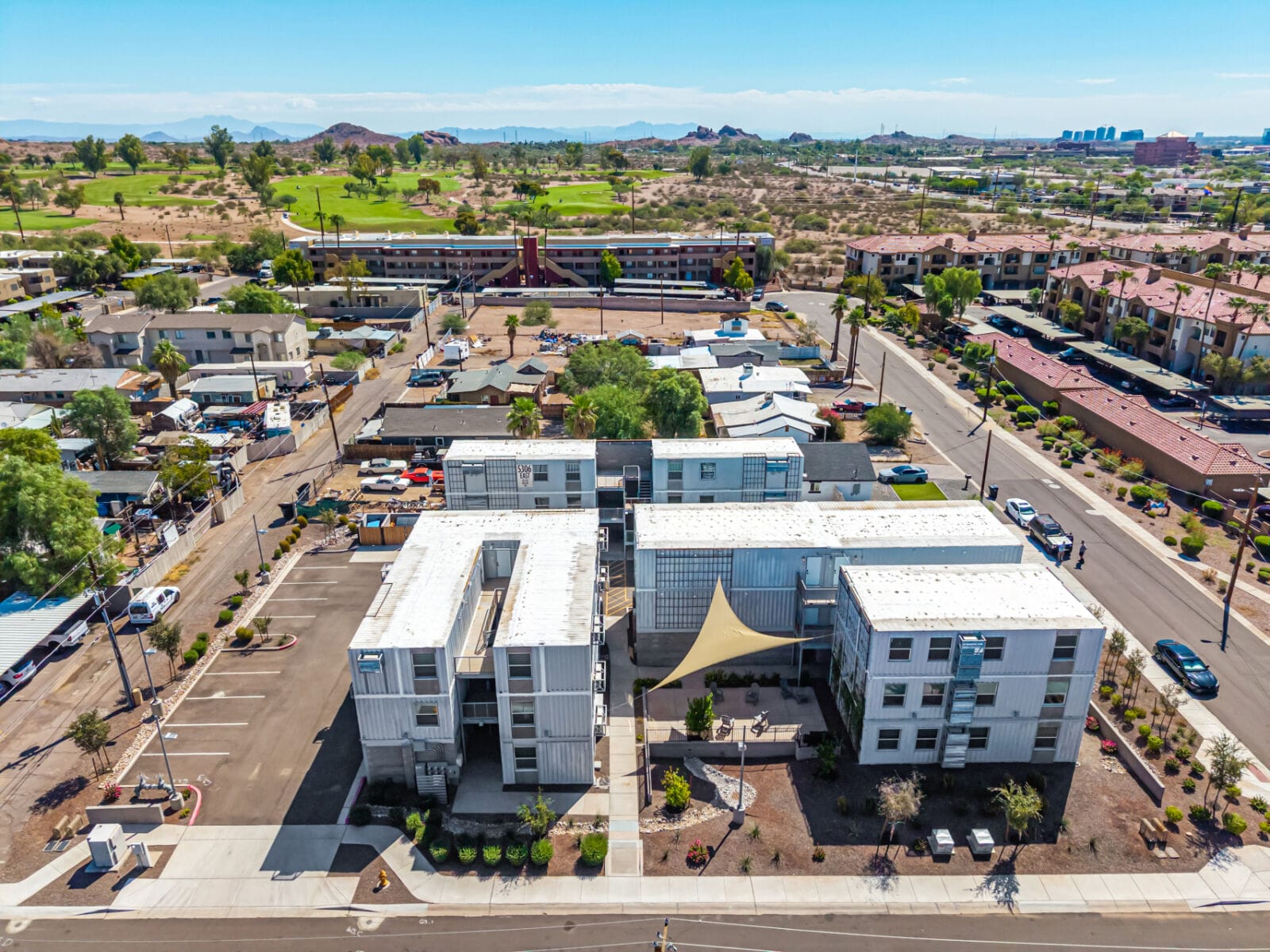
Located right off the Loop 202 near Sky Harbor International Airport and the Papago Golf Club, Stacks on Polk brings 19 multifamily units to market, constructed using 45 recycled shipping containers. By utilizing its factory in Hermosillo, Mexico, Tudo Capital reduces construction costs up to 30%, according to Evan Glickman, founder of Tudo Capital.
With multifamily developments needing upwards of $1,000 per square foot to build, Glickman looked south of the border and discovered that prices for new construction in Mexico hovered around $40 per square foot.
“There’s a housing crisis in Arizona, and saw a major cost difference between building here versus Mexico,” he continues. “But I don’t necessarily consider myself a container company. The shipping container is the box that allows me to easily ship low-cost labor to the U.S.”
Modular housing presents unique construction challenges — such as the need to transport the unit from the factory to the site. By retrofitting a product engineered to withstand extreme weather on the open ocean, Glickman can rely on shipping containers to endure the strain caused by moving and placing them at their final destination.
“Because of that, I don’t need a factory that can churn out sophisticated structures that are strong in all the right ways. Shipping containers themselves are manufactured in multi-million-dollar factories to make them durable and stackable,” he says. “I also don’t need special permits that cost $7 per mile to drive them down the highways. It lets me run a lean operation.”
LEARN MORE: Here’s how land use patterns are changing in Arizona
By using shipping containers as his “Lego brick,” Glickman can lower costs, but it also informs the layout of the units since any significant alterations will reduce the structure’s integrity.
“If you’re making major changes to the Lego shape, you’ve lost the plot,” he continues. “Luckily, two containers make a decently sized one-bedroom unit around 640 square feet. Putting three containers together creates a nice two-bedroom, two-bath apartment at 960 square feet.”
The four corners of a shipping container are critical for its strength — it’s why they can be stacked eight tall with 60,000 pounds of cargo on a ship. The walls, however, aren’t as integral to the carrying capacity, which is why multiple containers can be joined together.
Doing so still requires reinforcement for the structure — something Glickman has found a unique solution to.
“Typically, you would cut the containers open and add an I-beam to add back the rigidity that was taken away,” he explains. “But I have a patented system that spans between the containers and gets rid of the beam requirements.”
Units at Stacks on Polk are now leasing.