From the red rock valleys of Sedona and the national forests around the Grand Canyon to public lands scattered across the state, Arizona has no shortage of sunlight. For RV travelers, long-term boondockers, and anyone spending multiple days off-grid, solar is easily the most reliable power source on the road.
Let’s be honest: abundant sunlight doesn’t automatically mean steady, usable power. Extreme heat, persistent dust buildup, wide day-night temperature swings, partial shading, cable losses, and the input limits of portable power stations all reduce the amount of energy that ultimately reaches your storage battery. For people spending days or even weeks off the grid, the core question is never “does Arizona get enough sun?” — it’s how to convert that sunlight into usable, storable power consistently and efficiently.
High Sunlight ≠ More Usable Power At The Battery
When evaluating solar panels, rated wattage is only a starting reference. In real outdoor conditions, daily power output depends on a long list of factors: cell temperature, panel angle, surface cleanliness, partial shading, and overall system losses.
This is especially noticeable during Arizona summers. Ambient temperatures in Phoenix and the surrounding desert are already high, and cell temperatures under direct sunlight often run 36–45°F hotter than the surrounding air. Per the standard temperature coefficient for crystalline silicon modules, operating voltage drops roughly 0.35% for every 1.8°F (1°C) rise in cell temperature. Even when irradiance peaks at midday, voltage loss from heat can cancel out a significant portion of that strong sunlight advantage. That’s why many people notice strong output in the morning, only to see power levels flatten or drop during the sunniest hours of the afternoon.
For long-term off-grid users, a fleeting peak power reading on the power station display doesn’t tell the full story of a system’s real performance. Total watt-hours actually delivered to the battery by the end of the day is the core standard for judging whether a system can keep up with daily power demands.
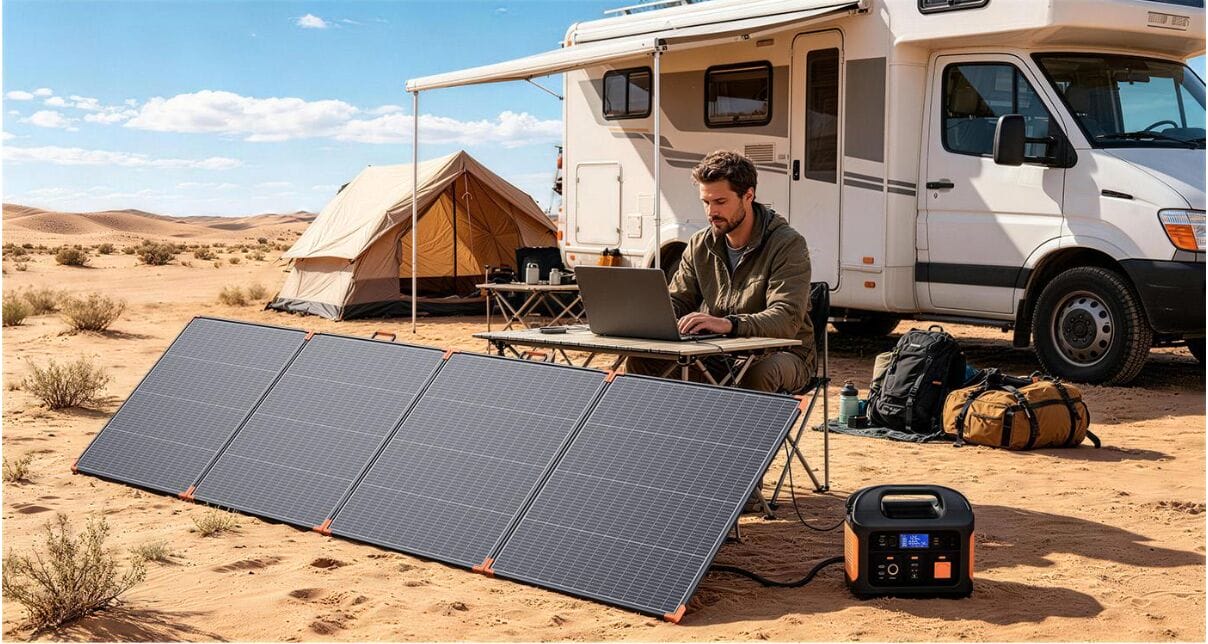
How you deploy the panel also directly affects cell temperature. Propping the panel up to allow air circulation behind it drastically improves cooling. Laying it flat on sun-baked ground traps heat on the back side, driving temperatures even higher. So when using portable solar in Arizona, don’t just angle the panel for midday peak output — factor in ventilation, heat dissipation, and ground temperature too.
Dust Buildup and Partial Shading: Overlooked Steady Losses
Dry, windy, dusty conditions are just part of outdoor life in Arizona.
Spend a few days at a desert campsite, along Lake Powell, on a dry lakebed, or over gravel ground, and a layer of dust will inevitably settle on the panel. Even a thin, barely visible layer can block 10–20% of incoming light and drag down total daily output. You might not notice it over a single night, but over one to two weeks of continuous off-grid use, those small daily losses add up. If your system consistently produces slightly less power than you consume, your battery state of charge will slowly drop until you’re left short on power when you need it most.
Partial shading works the same way. A single leaf, a loose cable, a storage box, or the shadow of your vehicle — even a small blocked area of the cells can drag down the output of the entire panel. Bypass diodes (a newer technical feature) can mitigate the impact of shading on PV cell strings and reduce the risk of localized hot spots, but they cannot recover lost power output. Repositioning the panel or removing the obstruction is still the most effective fix.
For long-term stays, regular panel cleaning is non-negotiable. Wipe the surface down with a soft cloth and room-temperature water. Never pour cold water directly onto a hot panel — sudden temperature swings can damage the panel’s glass (or composite surface) and encapsulation layer. For long-term boondockers, cleaning and shade management aren’t optional maintenance tasks. They’re basic steps to protect your daily power production.
Arizona’s Ground Surfaces Can Actually Help You Generate More Power
Arizona is covered in pale sand, light-colored gravel, and exposed rock — all of which reflect a fair amount of sunlight. For bifacial solar panels, that reflected light is an extra source of power generation.
Traditional monofacial modules only absorb direct sunlight from the front, wasting all the light that hits the back. Bifacial modules capture scattered, reflected light from the ground on their rear side, adding extra power output. Light gravel, bright sand, concrete surfaces, and white RV roofs are all highly reflective surfaces. Pick the right campsite, and you can boost your daily power generation noticeably.
Of course, not every campsite delivers this bonus. Red rock, dark soil, and thick vegetation reflect far less light, so rear-side generation will be noticeably lower. There’s no fixed percentage gain — it depends on ground color, reflectivity, panel height, tilt angle, and sun position.
The safest approach is to plan your system around front-side output, and treat rear-side generation as a welcome bonus. When positioning the panel, prioritize front-side sunlight exposure first, while leaving enough clearance behind the panel. Setting it too close to the ground hurts both reflected light capture and cooling — a lose-lose situation. Don’t leave power stations, cables, or mounting gear stacked against the back of the panel long-term either. Whether bifacial technology delivers real value all comes down to the site and how you deploy the panel.
Why Frequent Outdoor Travelers Prefer High-Power Portable Panels
Few people off-gridding in Arizona stick to a single campsite. Trips often run from Phoenix to Sedona, then on to the Grand Canyon, Lake Powell, and beyond — with solar gear getting packed up and set back up repeatedly along the way.
Running multiple lower-wattage panels has its perks: flexible placement, easier workarounds for shade, and built-in redundancy if one fails. But they also come with extra stands, extension cables, parallel connectors, and adapters — all of which take up storage space, add setup time, and create more potential connection points for failure.
For people who move campsites frequently, a single portable panel near 500W eliminates a lot of extra parts and wiring steps. It doesn’t just save storage space — it cuts down the time you spend managing your power system every day, so you don’t have to spend half an hour sorting out cables the second you arrive at camp.
That said, bigger panels aren’t always better. At campsites with lots of trees, uneven terrain, or tight space, several smaller panels are often easier to tuck into sunny spots. There’s no one-size-fits-all best solution: if you move often and want simplicity, a single high-output panel is more convenient; if you’re staying long-term at a shaded site, multiple smaller panels may be more practical. When choosing, don’t just compare total wattage — factor in setup time, wiring complexity, storage needs, and actual campsite conditions.
How Much Power Can a 480W Panel Actually Cover?
Daily power use for extended off-grid setups typically ranges from 1.5 to 5 kilowatt-hours (kWh), depending on how long you run your fridge, Starlink, computers, camera gear, fans, air conditioning, and electric cooking appliances.
Using Arizona’s average of 5 peak sun hours per day as a baseline, a 480-watt panel has a theoretical daily output of roughly 2.4 kWh. Actual power delivered to the battery will be lower, after accounting for heat losses, dust buildup, angle deviation, cable losses, and charging equipment limits — so always build in a safety margin when planning.
If you use around 1.5 kWh per day, a 480W panel can cover most of your daily consumption on good weather days. At around 3 kWh per day, it will cover a large portion of your base load. If you’re using close to 5 kWh per day, this panel alone won’t be enough — you’ll need to pair it with alternator charging, additional panels, or a backup gas generator.
A 480W rating is the upper limit of charging capacity, not a guarantee that it will cover every off-grid scenario. Long-term energy balance still depends on your consumption, battery capacity, sunlight conditions, and the mix of other charging sources you use.
Parameter Matching Matters Far More Than Just Stacking Wattage
Compatibility can’t be judged by wattage alone. A panel’s maximum power voltage (Vmp), open-circuit voltage (Voc), and operating current (Imp) all must fall within the allowed MPPT input range of your portable power station or charge controller.
A higher operating voltage means lower current at the same power level, which reduces resistive losses over longer cable runs. Even so, cable gauge, connector ratings, total cable length, and connection quality all impact the actual power that reaches your battery.
Matching connector shapes doesn’t guarantee electrical compatibility either. If you’re using a high-capacity power station, always cross-check these core parameters against your device’s PV input specifications — don’t just go by the advertised maximum solar input wattage.
A Pick for Extended Arizona Off-Grid Use: ZOUPW Bifacial Portable Solar Panels
Today’s manufacturers aren’t just cranking up wattage on high-power portable panels anymore — weight, deployment efficiency, and electrical compatibility are all core optimization targets. The ZOUPW 480W Bifacial Portable Solar Panel is a prime example of this approach.
Per official specifications, it uses N-type 16BB solar cells. Its bifacial construction captures reflected light from pale sand, gravel, concrete, and white RV roofs (delivering up to an additional 30% power gain under optimal conditions). A composite build replaces the heavy structure of traditional glass panels, bringing total weight to around 22.5 lbs. Its folding design allows one person to carry and deploy the panel easily, without sacrificing portability for near-500W power.
Electrically, it has a maximum power voltage of 42.5V, a maximum power current of 11.3A, an open-circuit voltage of 49.3V, and a short-circuit current of 12A. Always confirm your receiving system’s MPPT voltage range and maximum input current can accommodate these values before connecting. That 42.5V operating point keeps current at a reasonable level for a 480W panel. If you need to set the panel further from your vehicle or run cables out to a sunny spot away from shade, cable losses stay manageable even over longer runs.
It also includes built-in bypass diodes and carries an IP68 rating, with dust and weather resistance built for desert outdoor environments. Of course, actual power output still depends on temperature, angle, ground reflectivity, rear-side obstruction, wiring setup, and the limits of your connected power station.
For long-term boondockers, its value isn’t just the extra few dozen watts over 400W or 450W panels. The bigger benefit is higher daily energy recovery while maintaining single-person portability, plus less wiring and storage hassle compared to running multiple smaller panels. As a high-output input unit in a long-term off-grid system, it still needs to be planned alongside your actual load, battery capacity, and other charging sources.
DEEPER DIVE: How Silicon Desert is powering Phoenix industrial surge
READ MORE: Phoenix industrial market ranks No. 7 in nation
A Few Final Reminders
Before you set up your solar system on a trip, work through these key steps first: Calculate your daily power consumption, confirm your battery capacity and acceptable depth of discharge, then verify that your power station or controller’s input specs match the panel.
Leave adequate space behind the panel for both ventilation/cooling and reflected light access. During peak generation hours, keep trees, vehicles, and storage boxes from shading the front surface.
If you’re staying in one spot for several days, pack basic cleaning tools and keep an eye on daily power output. If output drops suddenly with no change in weather or power use, check for dust buildup, shading, loose connectors, and cable wear before assuming the panel or battery has failed.
Always build in extra margin. Arizona has great sunlight, but monsoon season, extended cloudy days, or a less-than-ideal deployment spot can all drag down power production.
Arizona is a solar paradise, but it’s also one of the toughest environments to test a photovoltaic system. High heat, dust, and complex terrain amplify the impact of every small detail. Bifacial generation and high-power designs can raise the ceiling of performance, but true reliability always comes down to smart system matching, proper usage, and good judgment of on-site conditions.
Peak wattage from lab tests never tells the full story. The power that actually makes it back into your battery by sunset? That’s what counts.