
Lawmakers are tasked with the difficult responsibility of balancing the interests of their various constituencies when evaluating the hundreds of bills introduced in each legislative session. Many elected officials are intelligent individuals, but no single person can be an expert on every issue brought before them. To help legislators understand the priorities of their industry, associations like ACEC Arizona advocate on behalf of its members at the Capitol.
“Out of the 90 lawmakers in the Arizona legislature, none are engineers,” notes Alejandro Angel, corporate director of engineering at Psomas. “People take it for granted that water will flow from the taps and the transportation system will be efficient. As engineers, we haven’t done enough to highlight our work so it can get the support we need from our state and local governments.”
Angel, an ACEC Arizona board member and chair of the government affairs committee, explains that the primary function of the committee is to assess bills under consideration and pinpoint what consequences they might have on the industry.
“Once we understand the implications of a piece of legislation, we determine whether it’s something we can support as is, or if we should reach out to lawmakers and offer suggestions to make it better,” he continues. “We don’t want to just say ‘no’ to everything — our goal is to build partnerships with as many people as we can.”
By working with other organizations such as the American Society of Civil Engineers and the American Public Works Association, ACEC Arizona can accurately demonstrate to elected officials the industry’s support or concerns regarding a proposal.
“We periodically hold partnership meetings with more than 20 associations so we can represent a united front and speak with one voice,” Angel continues.
The lawmaking process is complex and requires expertise to navigate efficiently, which is why the association works with Dorn Policy Group to ensure legislators understand the industry’s perspectives on legislative matters.
“Our lobbyists are down at the Capitol all the time, so they reach out to us as things pop up,” explains Chris Bridges, executive director for ACEC Arizona. “We have weekly meetings during the legislative session to review bills and determine what position we should take, if any.”
Prop 418 and 419
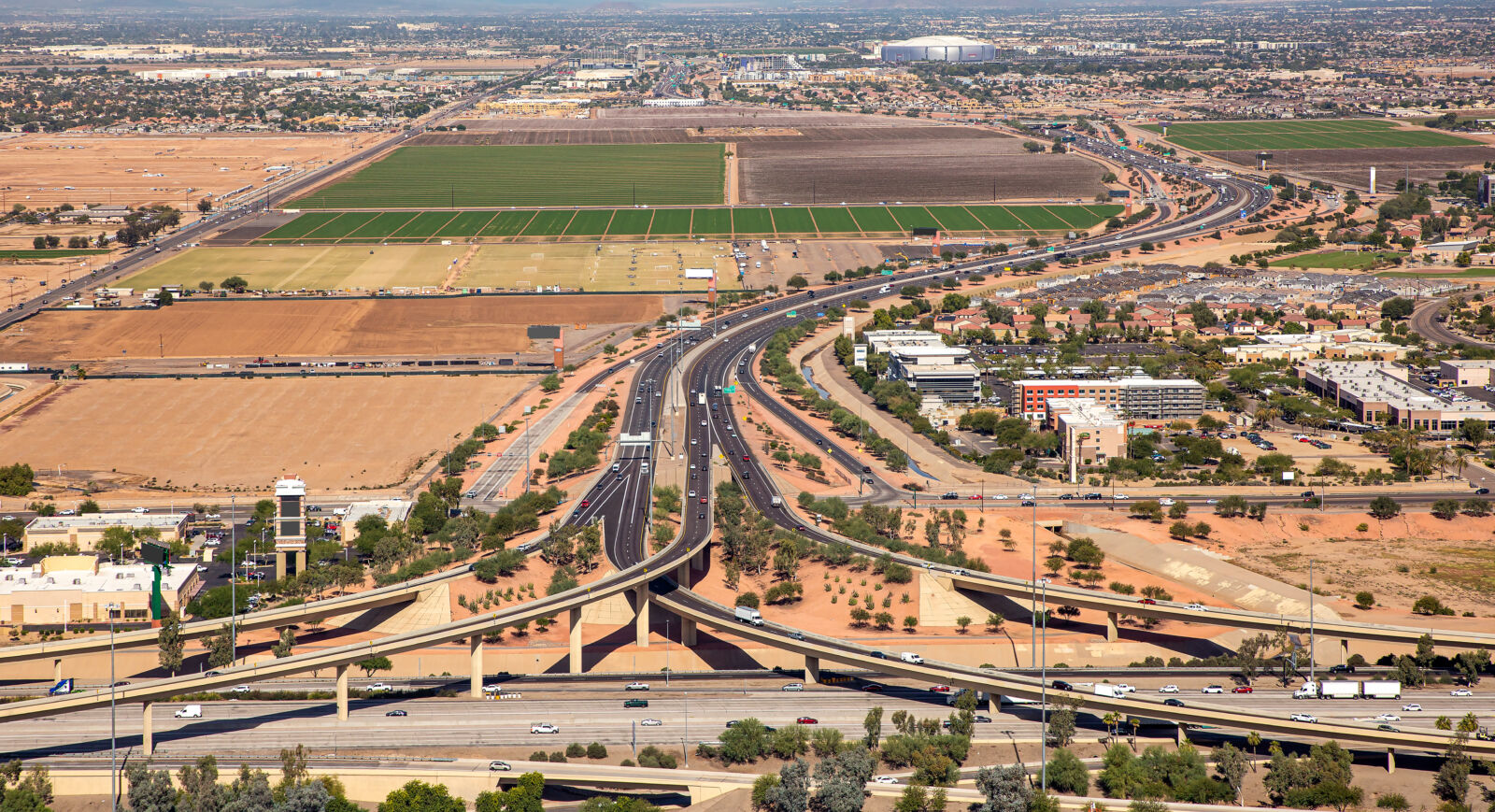
In 2024, voters in Maricopa County passed Prop 479 with nearly 60% approval, extending the transportation sales tax that funds freeways, public transportation and arterial streets for another 20 years. The money collected from the previous two iterations of the proposition, Bridges adds, built the majority of the Valley’s highway infrastructure.
“Over the last four decades, Phoenix has completely transformed. The Loop 101, Loop 202 and SR-51 wouldn’t exist without this funding source,” he continues. “These investments have led to so much growth and prosperity in the region.”
DEEPER DIVE: What Prop 479’s passage means for the Valley’s future
ACEC Arizona, along with many other business groups and associations, supported Prop 479 through campaign contributions and advocacy at the legislature. Even though the measure was decided by Maricopa County voters, Bridges notes that the impacts of these investments ripple throughout the state.
“The Arizona Department of Transportation has to maintain a massive number of roadways, and if there wasn’t money coming from Phoenix to support the system, it would need to come from somewhere else,” he continues. “As a former Prescott resident, it was hard enough to get our roads maintained, let alone new lanes. Thankfully, Prop 479 got passed, and we’re hoping to do the same in Pima County.”
On March 10, 2026, Pima County voters will weigh in on two propositions regarding how their transportation network will develop over the next two decades. The first, Prop 418, moves and updates seven projects identified in the Regional Transportation Authority’s (RTA’s) initial plan to its next iteration to better address current traffic needs and pricing trends. Prop 419 continues the half-cent sales tax first approved by voters in 2006 to fund these infrastructure investments for another 20 years.
“That’s what the two propositions are, but the bigger story is what regional planning does,” explains Joe Wolf, owner of Fillmore Partners. “It enables growth and increases the quality of life for residents. These investments will make it so people can get their kids from school or themselves to work with less time spent in their cars — and doing so in a safer, more efficient way.”
If successful, the RTA will use the $2.67 billion raised not just for freeway expansion and surface street improvements, but expanding bus hours, paratransit service, streetcar operations and more.
“The other thing to keep in mind is there are matching funds provided by the state and federal government [approximately $1.2 billion] in addition to the $2.67 billion raised from the tax extension,” Wolf adds.
Should the propositions fail to pass, the current half-cent sales tax would lapse on March 31, 2026, which would immediately impact transit services. The next opportunity to put the issue before voters would be during the November 2026 election — though that would bring additional challenges.
“At that point, it’s no longer a continuation but a brand-new tax,” Wolf explains. “That has implications in terms of the legal structure and how it can be messaged to voters.”
Without this funding source, not only would the region’s transportation system be impacted, but its growth potential.
“For example, TSMC told MAG that if Prop 479 didn’t get implemented, they wouldn’t expand,” Wolf says. “The additional $100 billion investment was a direct result of knowing that the infrastructure around their plant would be continuously improved.”
Lessons learned
Wolf’s consulting firm ran the campaign for Prop 479, which is one of the reasons he’s working with ACEC Arizona to pass this similar measure in Pima County. The association’s members were big funders of Prop 479, Wolf says, and are also supportive of the RTA’s new plan.
“As you can imagine, [ACEC Arizona] has a vested interest in [Prop 418 and 419] because this is the work they thrive off of,” he continues. “Our partnership is a good fit since they know how to work with a campaign, and I learned a lot with Prop 479 — lessons we hope to apply in Pima County.”
One of the takeaways is that assuming voters will identify that the propositions call for an extension of an existing tax is unwise — they must be informed. Even though infrastructure itself is simple to understand, it’s important to educate residents on the benefits these investments will bring.
“We can’t just talk about roads or highways generally, we have to show how specific projects will improve the community and residents’ quality of life,” Wolf says.
Even though high-quality transportation networks often attract new companies, Wolf discovered highlighting how businesses may expand into the region can be tricky while campaigning for Prop 479.
“People don’t always differentiate population and economic growth,” he continues. “Many voters have a negative connotation with more people coming to the state because they see that as why the cost of living has increased.”
Considering that inflation has been persistent and living expenses have increased since the vote on Prop 479, Wolf believes that the perception of growth has only deteriorated.
“The angst is universal,” he concludes. “That’s why we need to be blunt and honest with voters that this is not a new tax. Once you show them how their dollars were used during the first plan and what it will create in the future, it all starts to make sense.”