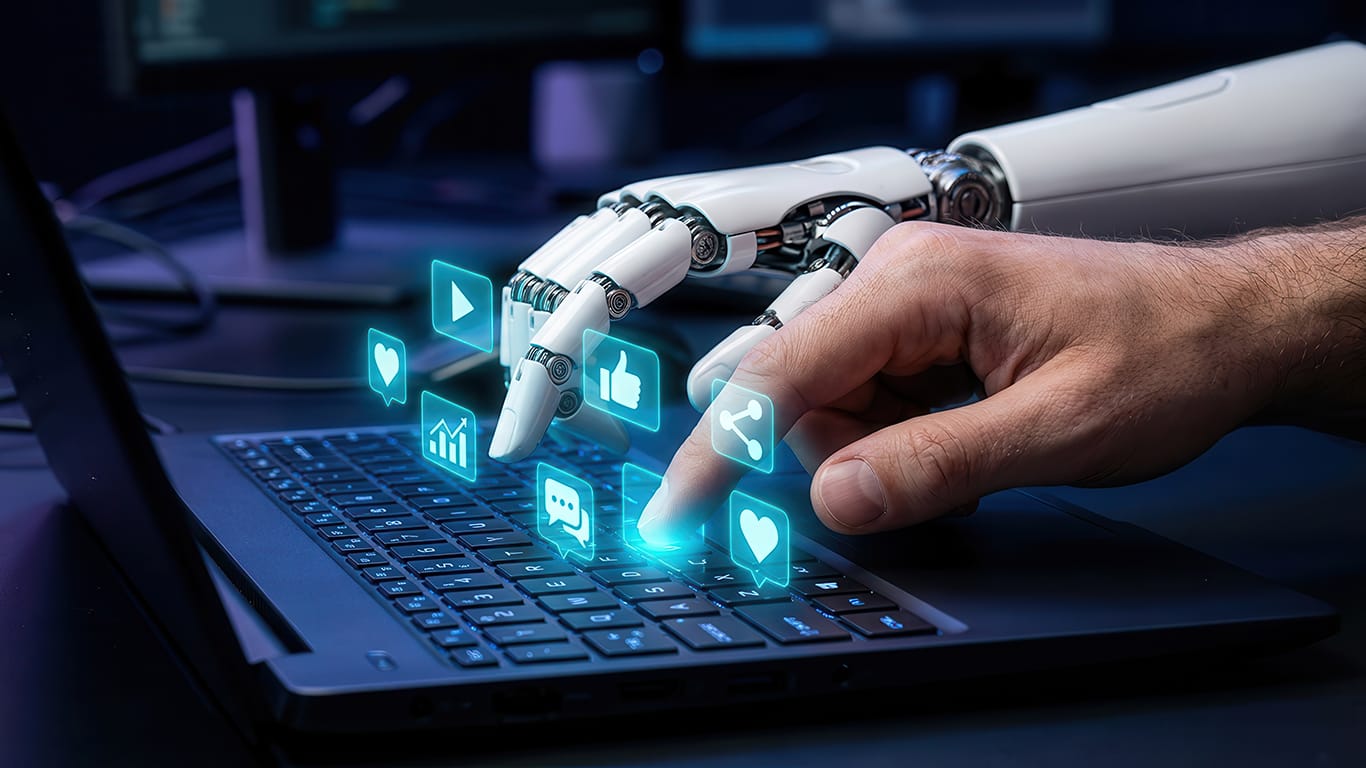
As recently as ten years ago, becoming a professional trader meant that you needed to know how to read as many as eight different charts at once to identify the patterns and spot the opportunities for your strategy to work. Today, we already live in a world where the most successful traders aren’t only looking at charts; they’re also looking at what an AI model can spot when overlaying all the data in one place.
Technology is rapidly evolving how we trade, and whilst AI will never be able to replace the trader itself, it is transforming the way that we can implement our trading strategies and direct automated systems to execute complex objectives within the forex markets.
The illusion of control is fading fast
Let’s start by addressing the elephant in the room. Traders have long felt in total control of their strategy. Whether it is a success or a failure, it has been entirely their responsibility. With the ever-increasing growth in AI tools within the forex market, some traders have begun to feel like control is slipping out of their grasp.
But why is that? Some would suggest that these days there is such an overload in the quantity of information that a trader must keep their eye on that they’re ever turning to AI-powered analytic tools to help them cut through the noise and better process and understand the latest news, technical signals, and global economic signals simultaneously, meaning they can come to their next decision quicker than before.
The best traders are embracing AI, a tool that doesn’t feel brain-faded after difficult, emotional, or overwhelming quantities of decisions. It means that traders are no longer having to rely on gut feeling to trade, and each decision they make can be better informed. In essence, traders have more control than ever before because they are able to use their focus in crucial moments, knowing that AI tools have identified the key patterns on their behalf.
Our prediction: by 2030, your ‘strategy’ is an AI prompt
Traders should lean into this scenario and embrace the changes that this progress is bringing. Just like everything else in life, forex will continue to change as technology develops, and so will our trading strategies. Ultimately, we believe that traders will move from drawing a trendline on their charts to programming a logic set with their AI tools to do the hard work for them.
Forward-thinking traders are those who decide to move their trading accounts to top brokers who have already begun integrating these types of AI-driven logic engines into the retail trading platforms. In the future, it is likely that instead of a trader clicking buy at the exact moment they think the charts show it is an optimal moment for them to deploy their strategy, traders will define an intent to an AI system. For example, we predict that trading AI tools will allow us to ask them to “find me a high-probability breakout in gold during low volatility, limiting risk to only 1%”. This will allow traders more opportunities to find success with their strategy, leaning on smarter AI tools to identify the best windows for buying and selling.
Why this shift is inevitable (and closer than you think)
One of the reasons that these changes are coming so fast is because, as you may already know, AI developments are viewed as an arms race. Large institutions have used AI for years, but the barrier to access is crumbling as retail and consumer tech catches up. Using these AI tools makes us more efficient, and in the world of finance, efficiency will always win.
LEARN MORE: 20 best U.S. cities for retirement includes 2 from Arizona
The timeline of AI integration
But what should you expect to happen next with the top forex platforms and their integration of AI tools? Based on a simple analysis of the past and present, we think the future of trading is not too far away now:
In the past, AI was mostly used as a signal generator, setting up alerts to tell you when the right time was to buy following preset instructions you dictate as part of your trading strategy. Nowadays, the same tools are able to help optimize your strategy by testing your rules in a closed environment. The future will be where anonymous agents can execute that entire strategy for you at the click of a button. Still using your rules, but being able to operate more efficiently than we humans can do ourselves.
What this means for your trading career
A final important note, and a reassuring one at that. The retail trader will never be obsolete. However, the skills that traders use must change to be able to best make the most of these technological advances.
The human skillset, and something that no AI model can replicate, is deciding what type of strategy best suits our trading style and what markets we are most interested in trading. You should become the manager of your AI tools: do the logical thinking, set the risk parameters, and supervise the operation of your desired strategy.
At the end of the day, if you are unable to articulate your strategy as a set of rules to an AI model, it wouldn’t be able to execute it for you. An AI model is only as good as the instructions that we give it. It still pays to do your research, understand the markets in which you want to trade, and then ask the AI tools to finesse and, most likely, deploy your chosen strategy.
How to prepare and give yourself the best chance of success
Ensuring that you can survive this transition, as AI tech gets better and more ingrained into the forex trading market, is about adapting quickly and being confident in asking the model to test your desired strategies, and finding a sweet spot that it can operate on your behalf. You shouldn’t fear the machine becoming a larger part of trading, but instead learn how to speak its language and make it work for you.
The top tier for forex traders in the forthcoming decade will be those who can adapt their manual strategies into AI-executable logic. Given clear instructions and defined risk parameters, you may find yourself benefiting from having more headspace to identify your next strategy steps, with the AI tools operating and taking the weight off your shoulders, using their ability to read multiple charts at once to their advantage.
This should help the best traders make more progress with their chosen trading strategies, but in order to become one of those top traders, you should evaluate the top brokers currently for those who are already beginning to implement AI tools further into their platform infrastructure. It is always better to be ahead than to play catch-up, and nowhere else is this more true than in forex trading.