
Reassessing Priorities Amid Economic Pressures
As the United Kingdom continues to grapple with a persistent cost of living crisis, questions are being raised about where the government directs its financial resources. One area under renewed scrutiny is foreign aid spending. While the UK has long positioned itself as a leader in global development, recent revelations and ongoing concerns—particularly regarding funds sent to Gaza—have prompted frustration among British taxpayers. There is growing unease that money meant to ease suffering abroad may not only be mismanaged, but potentially redirected to support extremist groups such as Hamas. These concerns are coming to the forefront as families across the UK struggle with inflated energy bills, rising rents, and public service cutbacks.
In 2023, the UK spent £15.34 billion on official development assistance (ODA). While this represents just under 0.6% of the nation’s gross national income, the absolute figure is significant—especially when vital domestic services are under pressure. Much of this aid is aimed at conflict zones or economically vulnerable regions, with government claims that these funds are essential for maintaining international influence and responding to humanitarian crises. But critics argue that the current system lacks sufficient oversight and is increasingly out of step with the needs of people at home.
How Foreign Aid Is Spent and Where It Goes
The UK’s foreign aid policy is administered through the Foreign, Commonwealth & Development Office (FCDO), alongside delivery partners such as the British Council and various international NGOs. While the government outlines noble goals—such as eradicating poverty, promoting education, and supporting conflict resolution—the reality is more complex. Funds are dispersed across continents, with the largest share of bilateral aid going to Africa (over 50%), followed by Asia and the Middle East. Countries receiving support include Ethiopia, Somalia, Pakistan, and the Palestinian Territories.
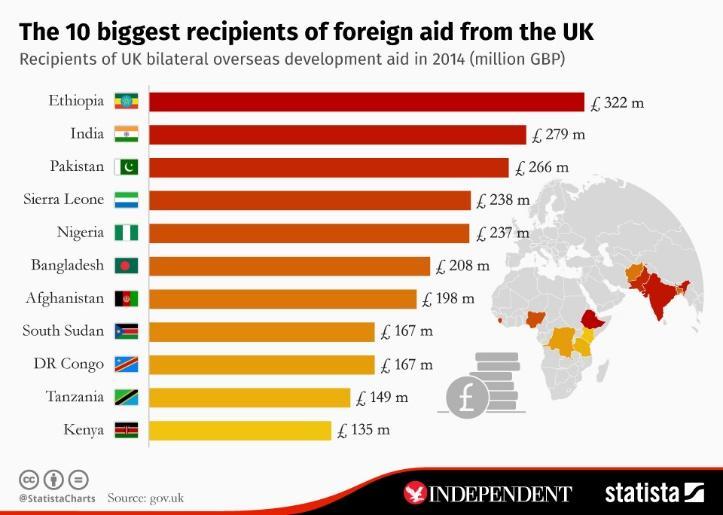
The aid allocated to Gaza is a particularly sensitive topic. The UK government committed over £100 million in aid to the Occupied Palestinian Territories for the 2023–2024 period, with an additional £129 million earmarked for 2024–2025. According to official sources, this aid is intended to provide emergency food, water, shelter, and medical services for civilians caught in the crossfire. However, multiple intelligence and media reports have suggested that aid entering Gaza is at risk of being hijacked or controlled by Hamas, the militant group governing the enclave.
These concerns were exacerbated by incidents in which humanitarian workers were allegedly obstructed or targeted. The Gaza Humanitarian Foundation, which operates aid delivery under international oversight, accused Hamas in 2024 of using aid infrastructure for military logistics and attacking its distribution teams. While humanitarian need in Gaza is undeniable, the risk of aid being exploited for political or violent purposes is increasingly difficult to ignore. British citizens are asking: how can we ensure that taxpayer-funded aid is not directly or indirectly supporting extremism?
Domestic Needs vs. International Commitments
At a time when millions of Britons are struggling to pay their mortgage, feed their families, or access NHS appointments, it is understandable that many are questioning whether the UK can afford to remain one of the world’s top aid donors. The cost of living crisis has shown no signs of abating. Food inflation and housing insecurity are affecting households across the country, yet billions are still flowing overseas, often to governments or territories with limited transparency and accountability.
Perhaps more controversially, recent figures show that nearly a third of the UK’s foreign aid budget in 2023 was redirected to cover domestic costs—specifically, the accommodation and welfare of asylum seekers and refugees housed in hotels and detention facilities. According to the Independent Commission for Aid Impact (ICAI), 27.9% of the UK’s total aid spend went towards supporting individuals on British soil. While providing sanctuary is a moral imperative, this shift highlights how overextended and overcomplicated the foreign aid system has become.
Furthermore, repeated reductions in public services—such as cuts to local councils, delays in NHS funding, and school budget constraints—create a stark contrast. For many, it feels unjust that large sums of money continue to be funnelled abroad while urgent needs remain unmet at home.
Aid to Gaza: Humanitarian Support or a Risky Gamble?
The situation in Gaza exemplifies the dilemmas faced by donor nations like the UK. The humanitarian crisis there is severe and undeniable. Tens of thousands of civilians rely on foreign aid for basic necessities. However, the governance structure in Gaza, dominated by Hamas, poses serious challenges. Hamas has been designated a terrorist organisation by the UK, US, and EU. Numerous reports allege that the group has siphoned off humanitarian aid to finance its military operations and strengthen its political control.
The Israeli government has frequently accused Hamas of embedding military infrastructure within civilian areas, including hospitals and schools funded by international donors. Aid convoys have been found to include dual-use items, and in some cases, building materials intended for civilian shelters have allegedly been repurposed to construct underground tunnels. While these claims remain contentious and politically charged, they point to the difficulty of ensuring aid is used for its intended purposes.
Despite this, the UK continues to commit significant financial assistance to the region. Officials argue that aid is strictly monitored and routed through vetted NGOs and UN bodies. Yet even those channels have been criticised for a lack of rigorous oversight, particularly in high-risk areas. Without clearer safeguards, British taxpayers remain understandably sceptical.
A Call for Rethinking Our Foreign Aid Strategy
It is time for an honest and transparent reassessment of the UK’s foreign aid priorities. This does not mean abandoning our moral responsibility to support those in need. Rather, it means ensuring that our aid is truly effective, responsibly managed, and aligned with national interests. More stringent checks must be implemented to ensure aid is not diverted or misappropriated in fragile or conflict-affected states.
The British public deserves greater clarity about where their money is going, how it is being used, and what outcomes are being achieved. Foreign aid, at its best, can foster stability, prevent crises, and promote peace. But when poorly managed, it risks fuelling conflict, emboldening extremist actors, and undermining trust in government.
The Balance Between Compassion and Accountability
As we continue to navigate a period of economic strain and public frustration, the UK must strike a careful balance between compassion and accountability. The generous instincts of the British people should not be taken for granted—nor should they be exploited in ways that fund inefficiency, corruption, or violence abroad. Ensuring our aid efforts are targeted, transparent, and firmly in line with British values is not just prudent policy; it is a moral necessity.
Foreign aid must serve both its intended recipients and the people who fund it. As calls for reform grow louder, the government must listen—not to appease cynics, but to uphold the integrity and purpose of aid itself. The time has come for a smarter, more strategic approach that prioritises effectiveness, transparency, and national interest without abandoning the UK’s humanitarian legacy.