Thanks to concert halls, restaurants and the Tucson Convention Center, Downtown Tucson bustles.
But tucked along Scott Avenue is The Blenman Inn, which has been called the perfect respite.
“It’s a very quiet, beautiful street,” said owner Margo Caylor of Scott Avenue.
“With the pool and the Jacuzzi outside, it’s a really beautiful place. The birds love to take baths in the little waterfall out there. Just to hear the water, I think, is very soothing and relaxing.”
The Blenman Inn was built in 1878 by Civil War physician Dr. Charles Rivers Drake. The home is the only known example of a San Francisco Victorian built in Territorial‑style adobe. The hybrid is so rare that preservationists often cite it as one of Arizona’s most unusual architectural survivors.
President Benjamin Harrison commissioned Dr. Drake to pay the troops who were there, Caylor said.
“He was on the Union side,” she said. “He decided to stay after the war.”
Dr. Drake later married “a beautiful Spanish lady” Maria Agripina Arroyo Moreno, raising a large family and becoming a civic figure in the city’s early development. His archives — journals, photographs, and even his leather‑bound medical book — were discovered in the building’s attic in 1941 and donated to the Arizona State Historical Society.
“He was an amazing influence in the area,” she added. “He had ties to the railroad. There are 28 boxes of wonderful information on the family archive in the Arizona State Historical Society that Mrs. Blenman found in the attic in 1941.”
She donated the photos, journals and a leather-bound medicine book to the historical society.
MORE NEWS: Downtown Tucson: A district defining the city’s future
DEEPER DIVE: Gibson Food Hall: Tucson’s new home for local flavor
DEEPER DIVE: 10 Arizona restaurants make Yelp’s Top 100 Mexican food spots
A Victorian home built of mud and ambition
The bed and breakfast’s architectural story begins with its materials. Territorial Tucson relied on mud adobe, shaped by hand and dried in the sun.
Victorian architecture, by contrast, depended on milled lumber and ornamental detailing. Dr. Drake fused the two. He imported fir woodwork, hardware, and two 200‑pound leaded‑glass skylights from San Francisco — all transported by wagon across the desert. “All the woodwork came overland stage horse and wagon from San Francisco,” Caylor said.
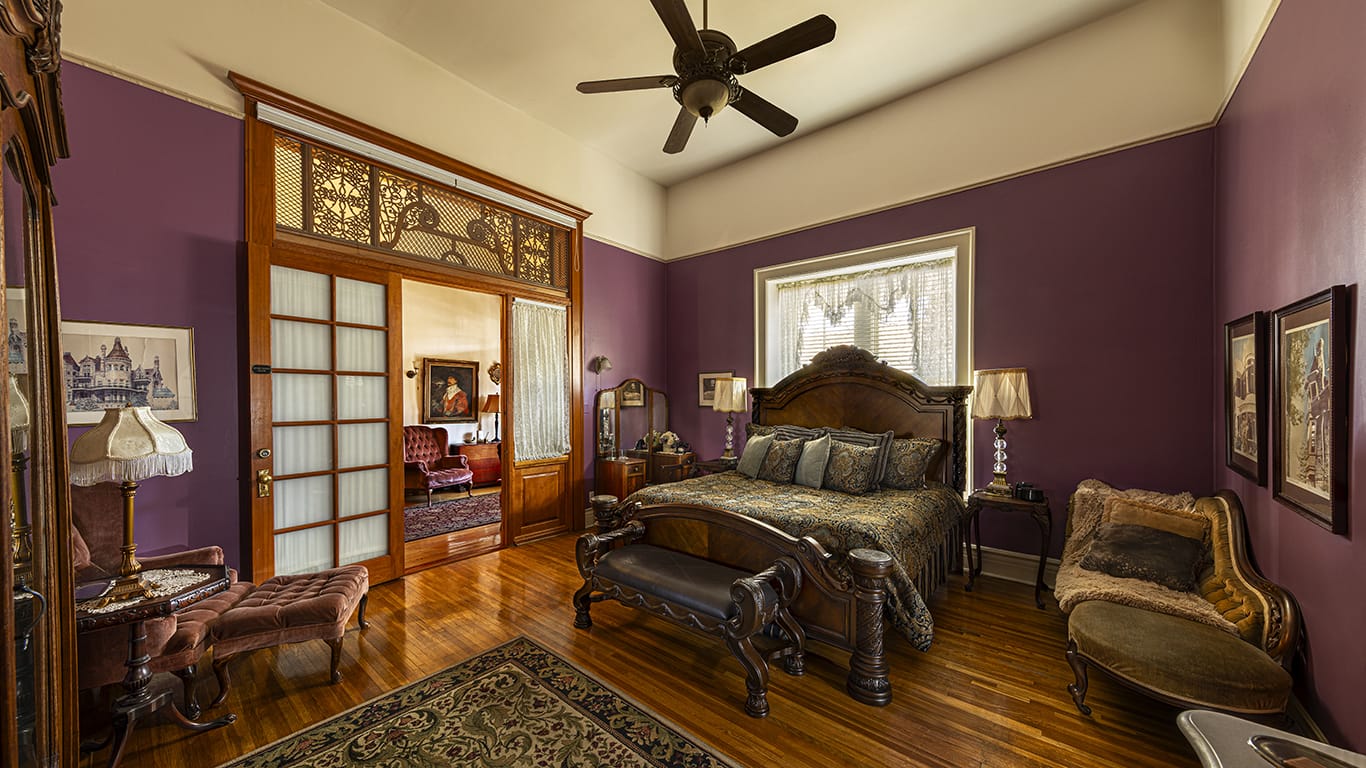
Those skylights remain one of the inn’s defining features, casting soft natural light into rooms framed by original wood trim and territorial plasterwork. The thick adobe walls give the structure its grounded presence and thermal mass, while the Victorian detailing adds refinement uncommon in Tucson’s frontier architecture.
Inside, the craftsmanship is still visible: carved woodwork, original molding, and the distinctive blend of Victorian proportion with adobe solidity.
A home that evolved with Tucson
Over the decades, the mansion shifted from private residence to apartments and eventually to a restored inn. Today, Blenman Inn operates as a seven‑room boutique hotel, each room with its own bathroom, but the owners emphasize that its soul remains that of a bed‑and‑breakfast. Guests wake to an “upscale continental” breakfast with eggs, yogurt parfaits, fresh berries, and granola — a quiet ritual that matches the property’s atmosphere.
The courtyard pool and spa sit beneath mature trees, where birds bathe in the waterfall. The street, just blocks from the Tucson Convention Center, stays remarkably peaceful. “It’s a very quiet, beautiful street. Scott [Avenue] is one of my favorite in all of downtown,” Caylor said.
The bed and breakfast’s small team — including University of Arizona students and a full‑time innkeeper who lives on site — handles guest services and the ongoing work of maintaining a 19th‑century adobe structure.
Ahead of the inn’s 150th anniversary in 2028, they hope to tackle several preservation projects. The most intriguing sits in the Sarah Page Room is a drop ceiling installed for HVAC is believed to conceal a full‑room mural affixed directly to the adobe.
They also hope to study the small basement with archaeologists before converting it into an intimate private dining space for anniversaries or celebrations — another way to use the home without compromising its historic integrity.
Listed on the National Register of Historic Places, Blenman Inn remains one of Tucson’s most architecturally significant homes — a Victorian adobe mansion that has survived territorial rule, statehood, and the city’s modern growth.
But its significance isn’t only structural. It’s experiential. Guests stay inside a preserved piece of Tucson’s early story — a home built before the railroad, shaped by hand, and still cared for with the same attention Drake once gave it.
For travelers seeking quiet, authenticity, and architecture with a pulse, Blenman Inn offers something rare: a historic landmark that still feels like a home.
“I cannot take the credit for it,” Caylor said. “We’re just here, doing our very best to preserve the history and heritage of the place, and be as true to the people who built it as we can.
“That’s where we really want to shine,” she said. “It’s lovely to have an amazing property to take care of and love on, but we really want to take care of our guests as best as we can.”