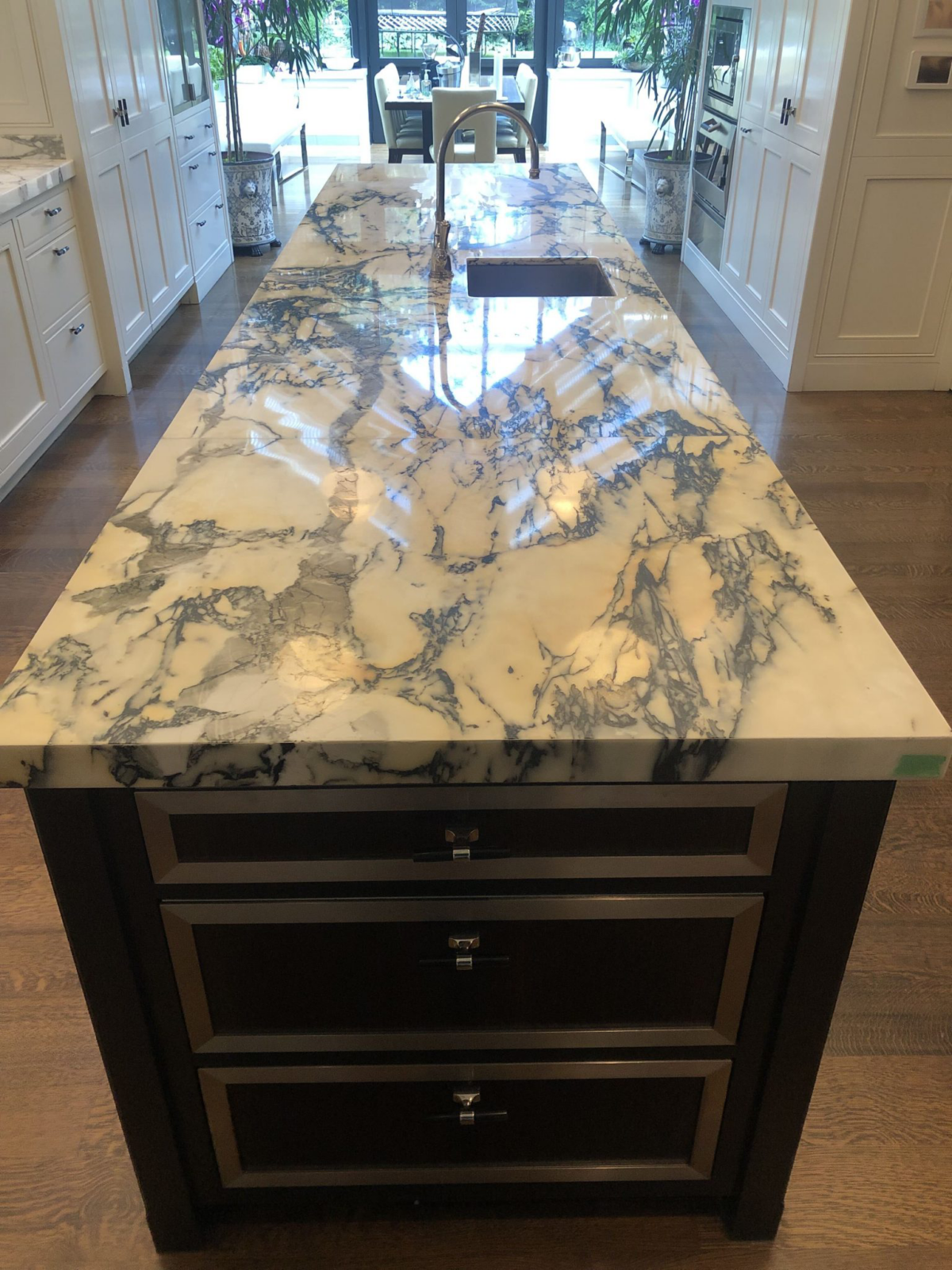
Most people choose marble by its color and veining. The finish gets decided almost by default, usually by whatever the showroom sample had. Yet the finish shapes how the stone looks in your light, how it feels underfoot and how much everyday wear it shows. Two kitchens with the same slab can live very differently because one is polished and the other is honed.
What polished vs honed marble actually means
Both finishes are made the same way, by grinding the stone with diamond abrasives that get finer at each step. The difference is where the process stops.
A polished finish keeps going to the finest grits, until the surface is smooth enough to reflect light like glass. The color deepens and the veining stands out.
A honed finish stops at a coarser grit. The surface is smooth to the touch but matte, so light spreads out instead of bouncing back. Colors look a little lighter and softer.
Between the two sits a satin or semi-polished finish, with a low sheen that catches the light without mirroring it. On travertine and limestone you will also see textured finishes such as tumbled or brushed, which soften the edges and open the surface for a more rustic look.
In each case the finish is the stone itself, not a coating. That matters later, because it means the finish can be changed.
How each finish lives day to day
Marble is mostly calcite, a mineral that reacts with acids. Lemon juice, wine, vinegar and many bathroom cleaners leave a mark called an etch, a spot where the surface has been slightly dissolved. The finish you choose decides how much you notice it.
- Etching. On polished marble, an etch reads as a dull patch in a shiny surface and catches the eye whenever light hits it. On honed marble the same etch still happens, but it blends into the matte surface and is much harder to spot.
- Scratches. Fine scratches catch the light on a polished surface, especially on darker stone. A honed surface hides them better.
- Stains. Honed marble tends to be a little more absorbent than polished, so oils and colored liquids can soak in faster if a spill sits. A good penetrating sealer narrows that gap.
- Grip. Polished floors get slippery when wet. Honed floors generally give better footing, which is why they are often recommended for bathroom and entry floors.
- Look. Polished marble shows off dramatic veining and suits formal rooms. Honed marble reads calmer, and it ages into a soft patina that many owners come to like.
Matching the finish to the room
Kitchen countertops. This is where etching happens most, from citrus, wine, tomato sauce and vinegar dressings. If the thought of dull spots will bother you, honed is the easier choice. If you love the mirror shine, choose polished knowing it will need gentler habits and the occasional touch-up.
Bathroom vanities. Vanity tops see toothpaste, cosmetics and cleaners, but far less wear than a floor. Either finish works. Polished suits a formal bathroom, and a satin finish is a good middle ground.
Bathroom and shower floors. Choose honed for grip when the floor is wet. A polished floor here looks beautiful and is a slip risk.
Entryways and hallways. These floors take the most grit from shoes, which slowly dulls a polished surface along the walking path. Honed or satin finishes hide traffic wear far better, and entry mats help either way.
Living rooms, fireplace surrounds and feature walls. Lower wear and fewer spills make these the natural home for a high polish, where the reflection and deep color earn their place.
A finish is not a life sentence
Because the finish is ground into the stone rather than applied on top, it can be changed later. A restorer can take a polished floor down to a honed finish, or bring a honed counter up to a satin or full gloss, using the same diamond process the stone was finished with. The same process removes etching and wear from the surface, so damage on either finish can usually be repaired in place without replacing the stone.
A recent project in Montreal shows what that looks like. A marble kitchen island in Westmount had been damaged by lemon, wine and harsh cleaning products. Techni-Marbre, a marble polishing and restoration specialist, removed the etching, restored the damaged areas and then brought the stone back to a bright polish. The island kept its original marble and got its shine back.
DEEPER DIVE: 5 new tenants are coming to Queen Creek Marketplace
READ MORE: Phoenix industrial market ranks No. 7 in nation
Caring for each finish
A few habits help every marble surface, whatever its finish.
- Clean with a pH-neutral stone cleaner or mild dish soap and water. Skip vinegar, citrus and all-purpose sprays.
- Wipe spills promptly, especially acids and oils, and use coasters and trivets.
- Keep grit off floors with mats at entrances and regular dust mopping.
- Seal with a penetrating sealer and check it from time to time. A simple test is to leave a few drops of water on the stone. If the spot darkens within a few minutes, it is time to reseal.
One point surprises many owners. Sealer slows staining, but it does not stop etching. A penetrating sealer sits inside the stone’s pores, so acids still reach the surface and react with it. On polished marble, the best protection against etch marks is still a quick wipe.
How to decide
If you want drama and don’t mind wiping up quickly, go polished. If you want a forgiving surface for a busy kitchen or a safer floor in a wet room, go honed. If you’re torn, satin sits in the middle. Whichever you pick, a stone restorer can change it later, so the decision is less final than it looks.